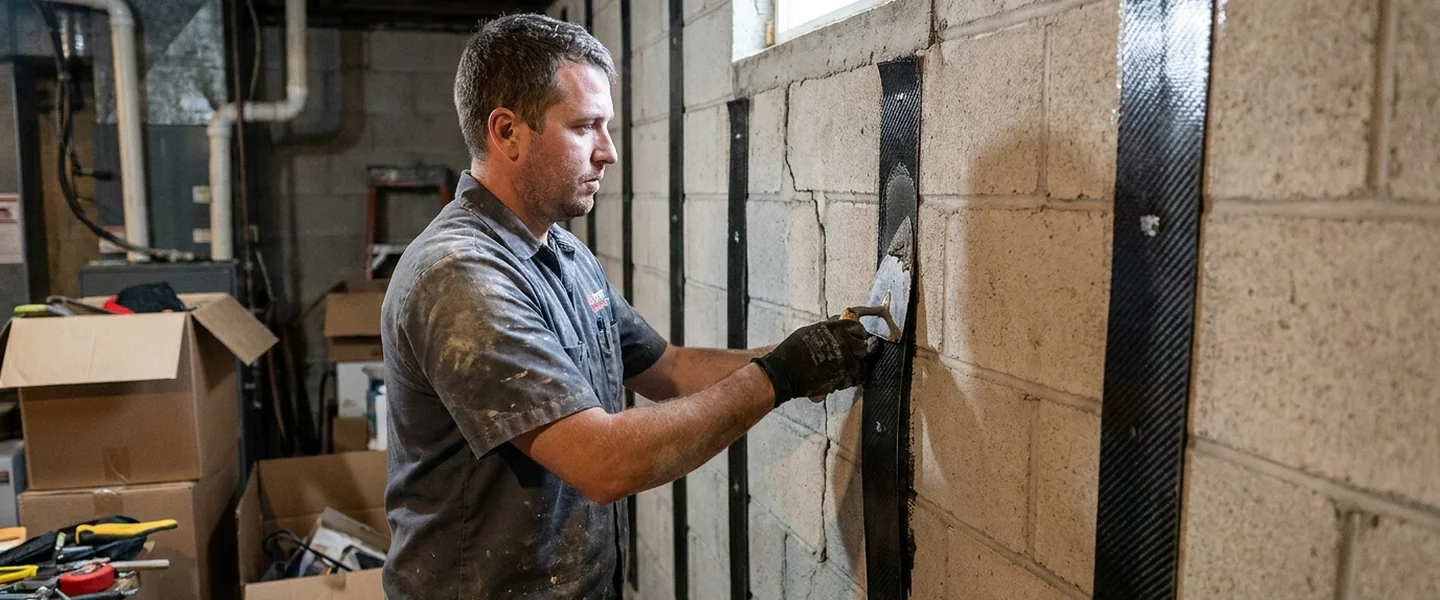
Bowing Wall Stabilization in Arlington, TX
Carbon fiber strap and wall anchor systems for bowing or leaning foundation walls — no excavation in most cases.
Call Now: (817) 904-3805A bowing or leaning foundation wall is one of the more serious structural conditions a North Texas homeowner can face. When expansive clay soil outside the foundation applies lateral pressure — either through soil weight, hydrostatic pressure, or the push from freeze-thaw cycles — the wall bows inward. Left unaddressed, the wall can crack horizontally, displace inward, and eventually fail. Arlington TX Foundation Pros installs carbon fiber strap systems and wall anchor systems to halt bowing wall movement and stabilize the wall against further displacement — typically without excavating. Call (817) 904-3805 for a free inspection.
What Causes Bowing Walls in Arlington, TX Homes
The Blackland Prairie clay soil throughout Tarrant County is highly expansive — it gains significant volume when wet. After heavy rainfall, the soil outside basement or crawlspace foundation walls expands and applies lateral pressure against the wall. In older homes where the foundation wall was not designed for this pressure, and where drainage around the perimeter is poor (downspouts discharging against the house, negative lot grade directing runoff toward the foundation), the wall will begin to bow inward at its midpoint — typically at the horizontal mortar joint midway up a block wall, or at a horizontal crack in poured concrete.
North Texas frost events compound this: when the soil near the surface freezes, it expands laterally as well as vertically, pushing outward and inward simultaneously. Older concrete block walls in basement foundations from the 1950s through 1970s are particularly vulnerable because the block material is weaker in horizontal shear than poured concrete or modern ICF construction.
Project Details
| Service | Bowing Wall Stabilization (carbon fiber straps + wall anchors) |
|---|---|
| Timeline | One day for most residential bowing wall stabilization |
| Carbon Fiber Method | No excavation — surface-mounted straps installed from interior |
| Wall Anchor Method | Minimal excavation — anchor plates installed in yard soil |
| Wall Movement Reversal | Wall anchors can gradually tighten over time to partially reverse inward displacement |
| Warranty | Lifetime warranty on carbon fiber straps; lifetime warranty on wall anchor hardware; fully transferable |
| Pricing | Quoted per job after free on-site inspection — every quote is itemized in writing |
Carbon Fiber Straps vs. Wall Anchors — Which Is Right
Carbon Fiber Strap System
Best for walls that have bowed 2 inches or less inward. High-strength carbon fiber straps bonded to the wall surface hold the wall against further movement. No excavation — one-day installation. Cannot reverse existing displacement, but permanently halts further movement.
Wall Anchor System
Best for walls that have bowed more than 2 inches or where gradual reversal of displacement is desired. Anchor plates installed in the yard soil are connected to wall plates by steel rods. Can be tightened seasonally over 1–2 years to slowly move the wall back toward plumb.
Our Bowing Wall Stabilization Process
- 1Free inspection and measurement. We measure the degree of bow (using a level and string line), assess crack patterns, and evaluate drainage conditions outside the wall. We determine whether carbon fiber or wall anchors are appropriate for the displacement level.
- 2Written quote. Strap count, anchor count, drainage recommendations, and warranty terms are all itemized in writing before work begins.
- 3Surface preparation (carbon fiber). The wall surface is cleaned, ground smooth at strap locations, and primed. Epoxy adhesive is applied, the carbon fiber strap is positioned vertically spanning from footing to sill plate, and the strap is rolled into the adhesive under pressure.
- 4Anchor installation (wall anchors). Access holes are drilled through the wall, anchor plates are pushed to the yard soil, and steel rods are tightened to draw the anchor plate into the soil. Wall plates on the interior are tightened against the wall surface.
- 5Drainage assessment and recommendations. We provide written drainage correction recommendations — grading, downspout extensions, or French drain — to reduce the hydrostatic pressure that caused the bowing.
- 6Documentation. Strap locations, anchor positions, and pre/post measurements are documented in writing. Wall anchor tightening schedule is included in the completion report.
When Bowing Walls Become an Emergency
A horizontal crack at the mid-point of a block or concrete wall with any visible inward displacement — even 1/4 inch — is a structural emergency. Once the wall has begun to shear horizontally, the load path from the structure above to the footing below is compromised. We prioritize these calls. If you are seeing a horizontal crack that is opening or a wall that is visibly tilting, call (817) 904-3805 and we will schedule an inspection immediately — not next week.
Warranty in Detail
Carbon fiber strap systems carry a lifetime warranty on the strap material and the bonded installation — the strap will not delaminate from the wall under normal conditions within the warranty period. Wall anchor systems carry a lifetime warranty on the anchor hardware. Neither warranty covers a wall that continues to be subjected to unremedied drainage or soil pressure conditions that exceed the system's design load — which is why drainage correction is always part of our recommendation. Both warranties are fully transferable to subsequent owners with written documentation provided at installation.
After Stabilization
Carbon fiber straps reach full cure strength within 24 hours. The wall can be painted or covered with drywall after cure — the strap profile is typically 1/8 inch above the wall surface. For wall anchors, the anchor nuts can be tightened seasonally (typically once a year in spring after winter soil expansion) to gradually draw the wall back toward plumb. We provide a tightening schedule and instructions. A 12-month recheck inspection is included with wall anchor installations to confirm position and tighten as needed.
Bowing Wall FAQs — Arlington, TX
How much inward bow is too much?
2 inches of inward displacement is the general threshold between carbon fiber (halt further movement) and wall anchors (gradual reversal). More than 3–4 inches of displacement on a block wall typically indicates the wall is at risk of shear failure and warrants emergency evaluation. We measure displacement at the inspection.
Can carbon fiber straps reverse existing bowing?
No — carbon fiber straps halt further movement but do not pull the wall back toward plumb. If reversing existing displacement is the goal, wall anchors with seasonal tightening are the appropriate system. We discuss the realistic outcome for each method in the written estimate.
Do I need to excavate for carbon fiber straps?
No — carbon fiber straps are installed entirely from the interior with no excavation. The straps are bonded to the wall surface vertically, from footing to sill plate. This is the primary advantage of carbon fiber over wall anchors for walls with modest displacement.
Will the straps show after installation?
Carbon fiber straps are approximately 1/8 inch in profile and 4 inches wide. They can be painted to match the wall or covered with drywall. For finished basements, they're typically installed before the finishing work. For unfinished basement walls, the straps are visible but minimal in profile.
What causes bowing walls in Arlington specifically?
The combination of expansive Blackland Prairie clay (which pushes laterally when wet) and poor perimeter drainage is the primary cause in Tarrant County. After significant rainfall events — particularly after dry summers when the soil rehydrates rapidly — the pressure spike against foundation walls can be substantial. Homes with gutters that discharge against the house or lots that slope toward the foundation are at higher risk.
Is bowing wall stabilization covered by homeowners insurance?
Standard Texas homeowners policies generally exclude foundation movement from soil pressure — the same exclusion that applies to settlement and piering. Coverage may apply if the wall damage was caused by a covered event. We document the damage thoroughly so you have the inspection record for any insurance inquiry.
Free Bowing Wall Inspection in Arlington, TX
Written estimate, no-excavation carbon fiber option, lifetime transferable warranty. Don't wait on a bowing wall.
Call (817) 904-3805Related reading: Signs Your Foundation Is Failing (Before It's an Emergency) | Foundation Crack Repair
What You Get in Our Quote vs. the Lowball Bid
We don't compete on the lowest sticker price — we compete on the quote that gets the job actually done. Here is what is included in every quote we write, and the cut-corners that show up in cheaper bids.
Included in our written quote
- Engineer-style elevation + crack assessment
- Soil and drainage evaluation
- Written quote with pier counts + warranty terms
- Photo documentation of every crack/movement
- Permit-pulling where required
- Post-install elevation re-check
Cut corners in the lowball bid
- Free-quote with no actual inspection
- Pier-count guesses without measurements
- Subcontracted installation crews
- Warranties that exclude common failure modes
- Pressure to sign at the kitchen table
- Same-day pricing tricks